By Marybeth Welty
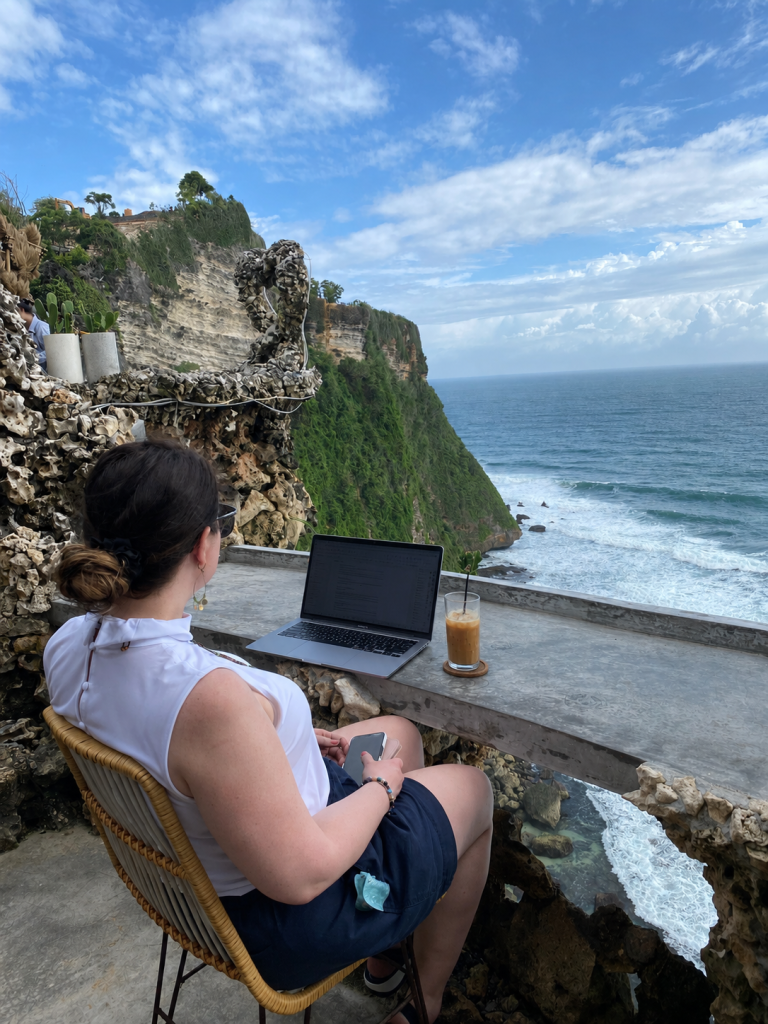
You’ve thought about it more than once this week.
Working from somewhere warm. Somewhere beautiful. Somewhere that doesn’t look like your home office at 10pm on a Tuesday with the same four walls closing in.
You’ve told yourself you’ll figure out the logistics “someday.” But someday is doing a lot of heavy lifting right now, and the trip keeps getting pushed to next quarter.
Here’s what I’ve learned after 19 years of traveling between the US and Canada, 11 countries, and one pivotal trip to Bali in 2025 that completely changed the direction of my business: the thing keeping most women entrepreneurs from their first real work + play trip isn’t logistics. It’s not knowing what the logistics actually are.
So let’s fix that. Right now. With a system that actually works.
This is the only post you’ll need to bookmark before your first international work + play trip. And if you’ve already taken one, this will fill in the gaps nobody tells you about.
What a Work + Play Trip Actually Is (And Why It’s a Different Category Entirely)
A work + play trip is not a vacation where you sneak in a few emails.
And it’s not a business trip where you collapse in a hotel room between meetings.
It’s a third thing. A trip where you show up fully as a professional, do real work that moves your business forward, AND actually experience the place you’re in. Spa days on Wednesday. Strategy sessions on Thursday morning. Dinner somewhere unforgettable Thursday night.
The reason most women struggle to make this work is that they pack like it’s a vacation but try to work like they’re home. Or they plan like it’s a work trip and spend the whole time in their room wondering why they bothered leaving.
The system in this post treats both lives as real. Because they are.
Step 1: Organize Your Business Before You Ever Open a Suitcase
The biggest mistake? Thinking you’ll figure out the business piece on the plane.
You won’t. And the first day abroad will be spent catching up on things that could have been handled before you left, which is a very expensive way to spend a Tuesday morning in paradise.
Put your business into what I call “Travel Mode”
Travel Mode is a pre-departure state where your business can run at approximately 70-80% capacity without your constant presence. Not zero. But enough that you’re not glued to your phone in the back of a tuk-tuk.
Here’s what that actually looks like:
Client communication: Set expectations before you leave. Not an out-of-office auto-reply. An actual message to your active clients that tells them your response window while you’re away (24-48 hours is reasonable and professional), what counts as an emergency, and how to reach you if one happens.
Delivery and deadlines: Audit everything on your plate for the next 4-6 weeks. What needs to be done before you go? What can be batched and scheduled? What can wait? Move aggressively on this list in the two weeks before departure.
Your systems and automations: This is the moment you’ll be very glad you have email sequences, scheduled content, and payment automations already running. If you don’t, this trip becomes the most expensive catalyst you’ve ever had to build them. (And honestly, that’s not the worst thing. The Freedom Business Society exists specifically to help you get this infrastructure in place.)
Your team or contractors (if you have them): Give them a clear decision-making framework before you go. What can they handle without you? What do they escalate? Put it in writing.
The time zone conversation nobody has
Bali is UTC+8. That means if you’re based in North America, you are looking at a 12-18 hour time difference depending on your coast.
This sounds terrifying. It’s actually freeing.
When your North American clients are sleeping, you’re fully present in Bali. And when Bali is waking up for dinner, your inbox might need 20 minutes of attention. Work in focused blocks. Schedule any required calls during your early mornings abroad, when it’s evening for your North American clients.
Time zones are only a problem when you haven’t planned for them. Plan for them.
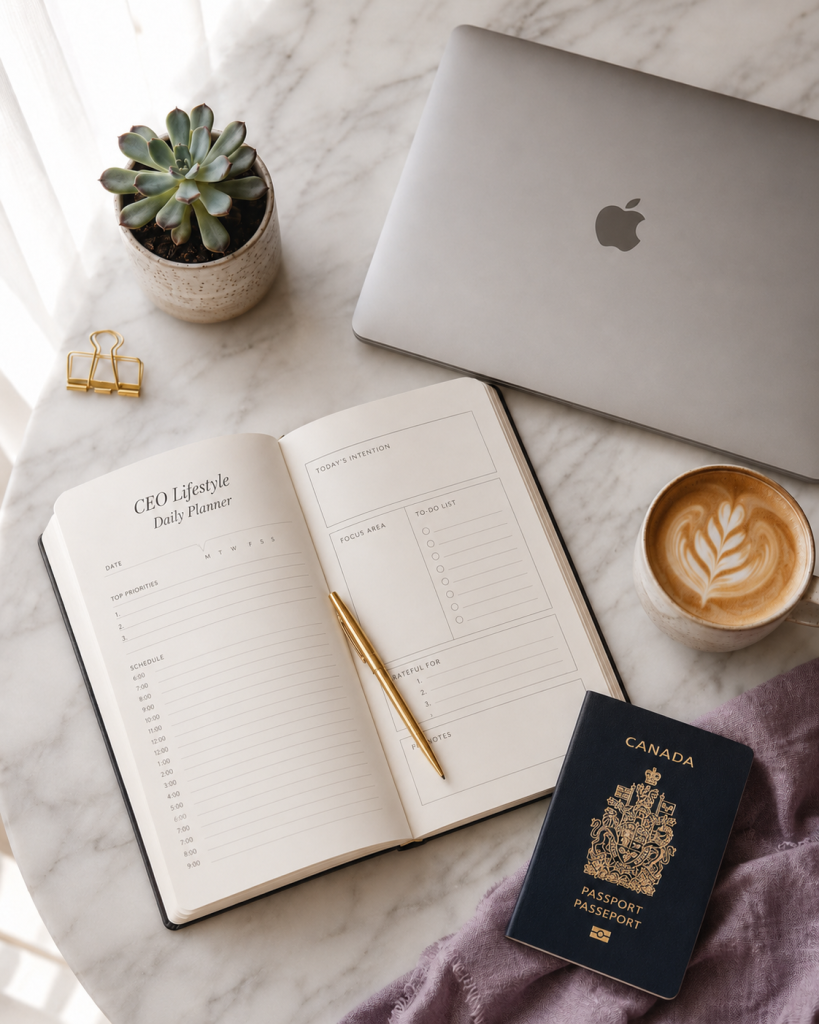
Step 2: The Work + Play Packing System (Finally, a Packing List That’s Honest)
The classic travel packing advice (pack light! only neutrals! capsule wardrobe!) was written for people who don’t need to look professional from a coworking space one hour and stunning from a rice terrace the next.
Here’s the actual system.
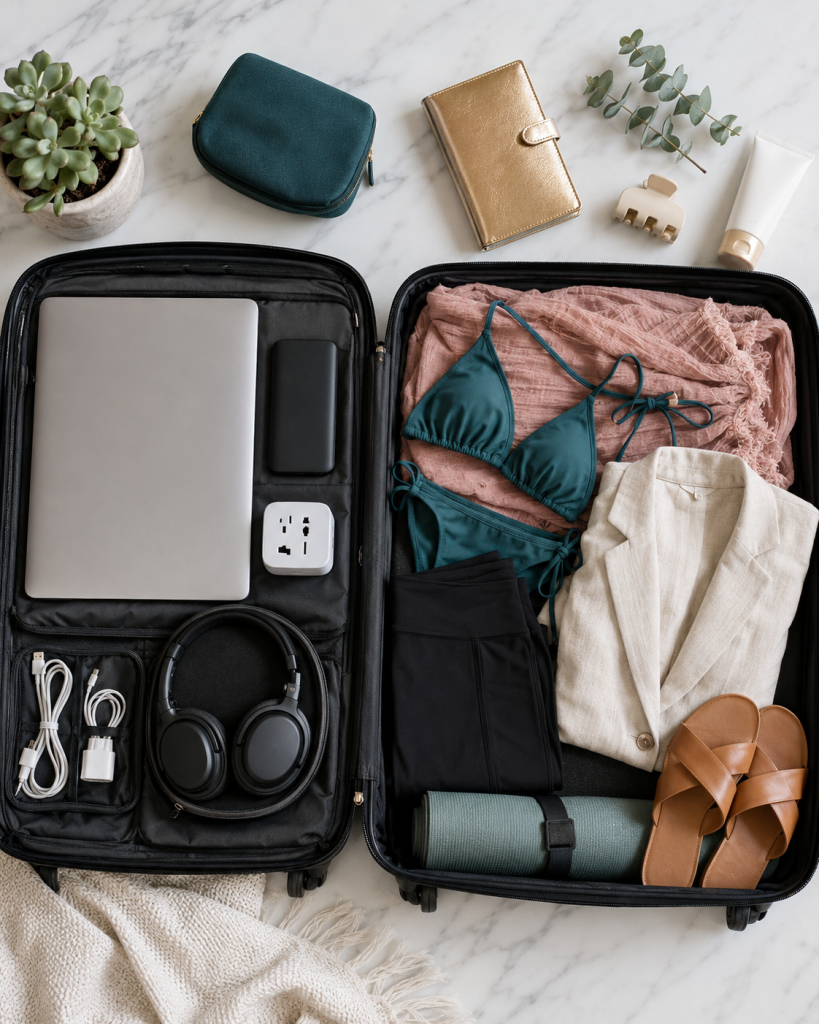
The Tech Stack
This is the non-negotiable list. Pack all of it. Check it twice.
- Laptop and charger (in your carry-on, always, non-negotiable)
- Universal travel adapter (get one that works in your destination country specifically, not a vague “universal” one that only covers half the outlets)
- Portable battery pack, fully charged before you board
- Noise-canceling headphones (for flights, for focus, for calls in open-air cafes with roosters nearby)
- Your phone, charged, with your carrier’s international plan confirmed before you leave home
- A small, portable WiFi hotspot as backup (yes, backup — more on WiFi in a moment)
- A physical notepad and pen, because sometimes the best thinking happens offline
The WiFi situation: Do not assume your accommodation has reliable WiFi just because it says it does. Before every trip, I identify two or three backup coworking spaces near where I’m staying. I know their WiFi speeds, their hours, and whether they require a purchase to use the space. This single habit has saved me from more than one presentation disaster.
The Wardrobe
You need two overlapping wardrobes that share pieces intelligently.
The work layer: 2-3 tops that photograph beautifully and look sharp on a video call. Wrinkle-resistant. Solid colors or subtle patterns (bold patterns fight with virtual backgrounds and distract on screen). A lightweight blazer or structured cardigan that elevates any outfit instantly.
The play layer: Swimwear (2 pieces minimum because things don’t dry instantly in humid climates), yoga clothes or activewear (you will want to move your body, especially if you’re doing any kind of retreat or wellness experience), one nice outfit for an elevated dinner or evening out, comfortable walking shoes, and sandals you can wear everywhere.
The overlap: Linen or cotton pants in a neutral that work at a cafe for work and out to dinner. A flowy dress that reads both casual and elegant depending on how you style it. A lightweight long-sleeve layer for sun protection that also works as a travel wrap on cold planes.
Leave home: the shoes that might be useful. The outfit for an occasion that might not happen. The fourth option in any category you already have three of.
The Stuff Everyone Forgets
- A good travel-size power strip (one outlet in an international villa can derail an entire morning)
- Reusable water bottle with a filter built in (for countries where tap water isn’t reliable)
- A physical copy of your most important documents: passport, travel insurance, accommodation confirmations
- Travel insurance details saved offline on your phone (the irony of being abroad, losing WiFi, and needing your travel insurance information is not fun)
- Melatonin or whatever you use to help with sleep when your body is adjusting
- A small first aid kit with anything you rely on that might not be available abroad: your specific allergy medicine, your preferred pain reliever, any prescription medications with documentation
Step 3: How to Actually Structure Your Days
This is where most work + play trips fall apart.
You either overwork because you feel guilty for being somewhere beautiful. Or you underwork because the somewhere beautiful is genuinely very distracting. Both leave you feeling vaguely bad about the whole thing.
Here’s the rhythm that works:
The Work + Play Day Template
Morning (6:00 – 10:00 AM local time): This is your most valuable block. The day is cool, your mind is clear, and most of your clients are asleep or offline. Use these hours for deep work only. Writing, strategy, anything that requires your full brain. No admin in this window.
Mid-morning to noon: Lighter work. Emails, quick client communication, scheduling, anything reactive. This is also when you do any video calls that require working with North American time zones, if needed.
Afternoon: This belongs to the trip. Spa. Adventure. Cultural exploration. Seeing something that makes you remember why you built a business that doesn’t require you to sit in an office. Do not schedule work here unless there is a genuine emergency.
Evening: Community and connection. Dinner somewhere memorable. Conversations with other entrepreneurs if you’re traveling with a group. Light reading. Journaling. Not your inbox.
The permission slip you probably need
You don’t need to work 8 hours a day to justify the trip.
That math belongs to a different kind of job. You’re a business owner. You’re not billing hours. And 4 focused hours in a beautiful location often outperforms 9 fractured hours in your home office. That’s not a loophole. That’s how creative, strategic work actually functions.
The work you do on a work + play trip is often disproportionately valuable because you’re thinking more clearly, you’re surrounded by stimulation and beauty, and you’re not fielding the same low-grade daily interruptions that erode your thinking at home.

Step 4: Money, Logistics, and the Details Nobody Romanticizes
Before you leave home
Notify your bank and credit cards. Do this. Every time. It takes three minutes and prevents the specific nightmare of having your card flagged at a restaurant in a country where you don’t speak the language.
Get some local currency at the airport. Not your entire budget. Just enough for the first 24 hours before you’ve located a reliable ATM.
Travel insurance is not optional. Get comprehensive coverage including trip cancellation, medical, and ideally a Cancel for Any Reason rider if there’s any chance your plans could change. Read the policy before you travel, not during an emergency.
Research your bank’s international ATM fees. Some are brutal. A Schwab or similar bank with fee reimbursements is worth having for international travel.
On the ground
Get oriented on your first day, not your first morning. Don’t try to be productive the day you land. Arrive, settle, eat something, sleep. Start the rhythm the next day.
Identify your go-to spots in the first two days. Your preferred cafe for focused work. Your backup WiFi spot. The grocery store or market. A reliable way to get around (Grab, the regional Uber equivalent, is your friend in Southeast Asia). Once you know where things are, you stop burning mental energy navigating.
Keep your accommodation details saved in multiple places. Offline, in your notes app, and on a physical piece of paper in your bag. Getting lost with a dead phone in a place where you don’t speak the language is a situation you can prevent easily.
Step 5: Coming Home (The Part Nobody Talks About)
The return from a work + play trip hits differently than coming home from a vacation.
On vacation, you come home rested but vaguely sad. On a work + play trip, you come home with something else: a different sense of what’s possible. What your business could look like. What your days could feel like. The gap between that clarity and your regular Tuesday becomes very obvious very fast.
This is the moment most women entrepreneurs either act on the clarity or let it fade.
The re-entry protocol
First 48 hours back: Jet lag is real. Do not schedule anything important for the first 48 hours back. Protect your sleep. Drink water. Let your body land.
First week back: Do a business debrief while the trip is fresh. What did your business reveal while you were away? What worked in the systems you set up? What gaps showed up? What do you want to change? Write it down while you remember.
First month back: Implement one change from the debrief. Just one. The women who travel and come back with 12 priorities end up implementing zero. Pick the most impactful thing and move on it.
The Shortcut: Travel With Women Who’ve Already Figured This Out
Everything in this post is learnable. You can do it solo, through trial and error, over a few trips.
Or you can skip the learning curve entirely.
The Bali Elite Retreat, February 2028 is a 1 or 2-week work + play immersion for high-impact women entrepreneurs, designed specifically so that your first real international work + play experience is extraordinary, not experimental.
You get the 10-bedroom private villa with infinity pools overlooking rice terraces. The private chef. The morning wellness sessions with a private instructor. The afternoon spa treatments. The curated adventure days with a private guide. The business strategy workshops and co-working sessions that make this an actual business expense, not just a beautiful trip.
And you do all of it alongside 10-12 women who understand what it means to build a business and a life that doesn’t require you to choose between the two.
The retreat moves to February 2028. Exact dates are being finalised now and go out to the waitlist first.
Spots are limited to 12 women. The May Early Bird rate saves you $500, and a $500 deposit holds your spot today.
Questions? Email hello@sustainablelifestylesolutions.com or message on WhatsApp at +1 604-785-4075.
Not Quite Ready for Bali? Start Here
If a luxury 2-week retreat in Bali feels like the next conversation but not the next click, start with something free.
Insider Secrets is my Friday newsletter, where I share the systems I am actually running that week, whether I am in Vancouver or Ubud. It is written for women who want to do real work and real life without one destroying the other.
Comment PLANNER below or grab it directly at the link below.
Get Insider Secrets free, every Friday
About Marybeth Welty: Marybeth is a business coach, systems strategist, and the founder of Women Entrepreneurs Who Travel. With 19 years of experience traveling between the US and Canada and across 11 countries, including multiple work + play trips to Bali, Japan, and throughout Southeast Asia, she helps women entrepreneurs build businesses that give them time freedom, location freedom, and financial freedom. She is the host of the Bali Elite Retreat, February 2028 and the creator of the Freedom Business Society. Connect at sustainablelifestylesolutions.com and on Instagram at @womenentrepreneurswhotravel.
Want more? Join the Women Entrepreneurs Who Travel Facebook community, where we talk about all of this and more, every week.
And every Friday, the WEWT Insider Secrets newsletter drops into the inboxes of 15,000+ women entrepreneurs with travel tips, business systems, and the real talk about what location freedom actually looks like. Subscribe here.
If you are not sure your business can take the weight yet, run the travel-ready test first. If your files and client details are the part that worries you, fix that with one home per kind of information and three AI employees before you pack. For the travel itself, seven habits of women who do this constantly covers the logistics side.
Questions women entrepreneurs are asking about this
What is a work and play trip?
A trip where you keep working at reduced capacity rather than switching off entirely, so the trip can be longer and less expensive per day than a pure holiday. It is its own category with its own rules. Treating it like a vacation leaves clients stranded, and treating it like a normal work week wastes the trip.
How do I put my business into travel mode?
Decide in advance what pauses, what runs at reduced capacity, and what continues untouched. Set the response times you can genuinely hold, tell clients before you leave rather than by auto-responder, and move anything time-critical to either side of the trip.
How do I handle time zones with clients while I am traveling?
Pick the two or three hours that overlap with your clients’ working day and protect them, rather than trying to stay available across their whole day. Say the specific hours out loud to clients before you go. Vague promises about being reachable are what create the 2am messages.
What should I automate before I travel?
The things that break silently: invoicing and payment reminders, appointment confirmations, and inbox triage so nothing urgent sits unseen for a day. Automate the routine and keep every judgment call about a specific client with you.
How far ahead should I plan a working trip?
Far enough ahead to move the deadlines that would have landed mid-trip, which for most service businesses means four to six weeks. The planning that matters is the business calendar, not the itinerary.
ABOUT MARYBETH WELTY
Marybeth Welty is a business coach, systems strategist, and founder of Women Entrepreneurs Who Travel and Sustainable Lifestyle Solutions. She has spent 19 years traveling between the US and Canada and across 11 countries, building and running her businesses from villas, co-working spaces, cafes, and everything in between.
These days she builds AI employees: the assistants, planners, and follow-up systems that run the parts of a business that used to take up half of a founder’s whole week. She helps women entrepreneurs put those systems, their offers, and their mindset together so they can work from anywhere and actually enjoy the life they built the business for.
Follow her on Instagram @womenentrepreneurswhotravel, or come join the free Facebook community, Women Entrepreneurs Who Travel.